
For years, search meant typing a question and choosing from a list of blue links. Today a growing number of people ask ChatGPT or Gemini and read a single written answer, often with a few cited sources. If your brand is not part of that answer, many of those people will never see you.
That raises a fair question for anyone who works in SEO: do the things that built visibility in Google, mainly backlinks, still work here? And do plain brand mentions, with no link at all, now matter just as much? This guide explains what we know, what we do not, and what is worth doing about it.
A note on honesty: AI search systems are not public, they change often, and nobody outside the companies that build them can say exactly how they choose sources. Where we describe evidence below, we say whether it is documented or only a pattern people have observed.
How ChatGPT and Gemini find the information they use
Large language models learn from huge amounts of text during training. But when you ask about something current, such as the best tools in a category or a company you are researching, many AI assistants also search the web and then write an answer based on what they find.
- Gemini and Google's AI features are connected to Google Search, so pages that Google already crawls, indexes and trusts are the pool they draw from.
- ChatGPT can use a web search feature to find and cite pages when a question needs fresh information.
The practical lesson is simple. If a page is not findable, crawlable and credible on the open web, it is much less likely to be used as a source. That is the point where backlinks and brand mentions come in.
Where backlinks fit in
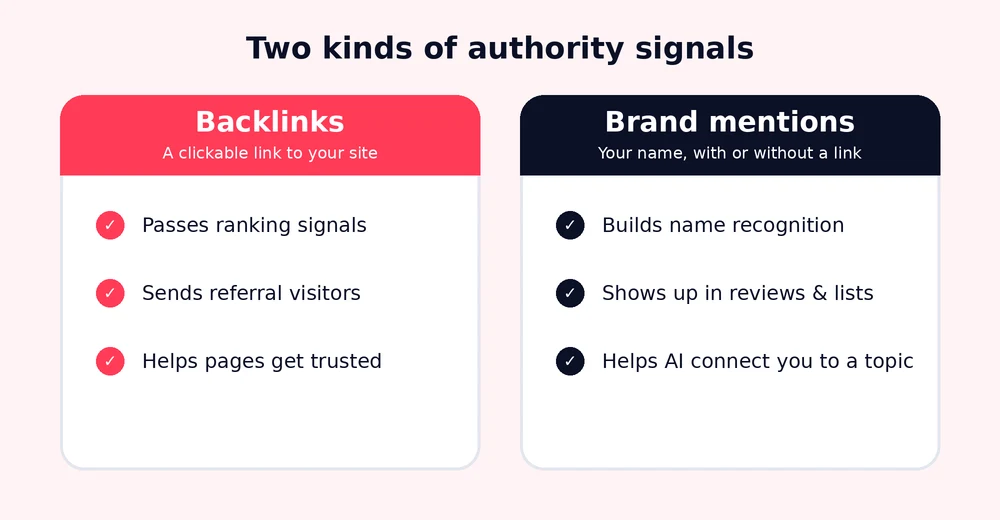
A backlink is a link from another website to yours. Search engines have used links for a long time as one signal that a page is worth trusting, because real sites tend to link to useful pages. Since AI tools that browse the web depend on search results, links still help in a few ways:
- They help your pages get discovered and indexed. A page that is linked from other sites is easier for crawlers to find.
- They support ranking. Pages that rank well in search are more likely to be seen by systems that pull from search results.
- They send real visitors. A link inside a helpful article can bring readers, whether or not an AI is involved.
This is why relevance matters more than volume. One link from a respected site in your niche is worth more than dozens from unrelated pages. We explain this in our guide to contextual backlinks.
Where brand mentions fit in
A brand mention is any place your company, product or founder is named on the web, with or without a link. Think of reviews, comparison articles, podcasts, news coverage, forum answers, directories and expert roundups.
Mentions matter for AI visibility because language models work with words and ideas, not only links. When many trustworthy sources describe your brand in connection with a topic, a model has more evidence that you belong in an answer about that topic. A link is a vote. A mention is also a description of who you are and what you do.
What the evidence says (and does not say)
Several SEO research teams have studied which factors go along with brands appearing in AI-generated answers. A pattern that has been reported more than once is that the number of times a brand is mentioned across the web tends to show a stronger relationship with AI visibility than the raw number of backlinks does.
Two cautions apply:
- Correlation is not causation. Big, well-known brands collect both mentions and visibility. The mentions may be a sign of that fame rather than its cause.
- The systems keep changing. A finding from one study, on one set of questions, at one point in time may not hold next quarter.
So we do not recommend choosing between links and mentions. The sensible reading is that both are signs of a brand that other people trust and talk about, and that is what you want to build.
Why the best strategy earns both at once
The good news is that the same work produces links and mentions together. A guest article on a respected site in your industry gives you a relevant link, a mention of your brand, an author bio that explains who you are, and a new audience. A genuine expert comment in an article does the same. Our overview of guest posting shows how this works in practice.
What does not work is shortcuts: mass-produced low-quality links, paid links that pretend to be editorial, or fake reviews. They go against Google's spam policies, can damage trust with people, and are the opposite of the credible footprint AI systems look for.
A practical plan to improve your AI visibility
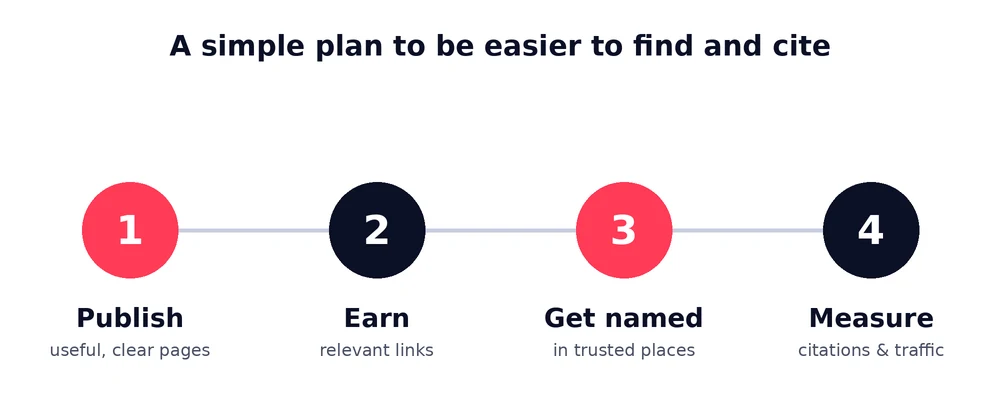
- Make your own site easy to understand. Clear pages that say what you do, who it is for and how you are different give both people and machines something solid to quote. Add an About page, author names and honest contact details.
- Answer real questions. Write helpful, original pages that answer the questions your customers ask, in plain language. Short, direct answers followed by detail are easy to quote.
- Earn relevant links. Focus on sites your audience actually reads. Use the guest post site checklist to avoid weak or risky placements.
- Get named in trusted places. Look for industry roundups, expert quotes, podcasts, reputable directories and genuine customer reviews. Be consistent with how your brand name is written everywhere.
- Keep the technical basics healthy. Do not block search crawlers by mistake, keep pages fast, and submit a sitemap so new content is found.
- Measure and adjust. Check Google Search Console for impressions and clicks. Every month, ask ChatGPT and Gemini the questions your customers would ask, note whether your brand appears and which sources are cited, and look for patterns. Results vary between asks, so record several attempts rather than one.
Common mistakes to avoid
- Chasing guarantees. Anyone who promises that an AI tool will recommend you is promising something they cannot control.
- Ignoring relevance. A mention or link on an unrelated site does little for you.
- Over-optimised anchor text. Repeating the same keyword in every link looks unnatural. Use a natural mix, including your brand name.
- Neglecting your own content. Links and mentions point people somewhere. If the page they land on is thin, you waste the effort.
- Expecting overnight results. Authority builds over months, the same way it always has.
The bottom line
AI search changes how people see answers, but it has not changed what earns trust: useful content, real expertise, and other credible sites that link to you and talk about you. Backlinks help your pages get found and trusted. Brand mentions help systems and readers understand who you are. Build both, stay honest about what you can control, and measure results over time.
If you would like help earning relevant links and mentions on real sites, see our link building services or ask for a free proposal.
Frequently asked questions
Do backlinks still matter for ChatGPT and Gemini?
Yes, indirectly. These tools often rely on web search results to find sources, and links remain one of the signals search engines use to judge which pages are trusted. Nobody outside these companies can say exactly how much weight any signal gets, so treat links as one part of a bigger picture.
Are brand mentions without links useful?
They can be. An unlinked mention in a respected article, review or list helps people and AI systems associate your brand with a topic. A linked mention does both jobs at once, so the best results come from earning both.
Can I guarantee that ChatGPT or Gemini will recommend my brand?
No. These answers vary by question, by user and over time, and no agency or tool can guarantee a mention. What you can do is make your brand easier to find, easier to understand and easier to trust.
How long does it take to see results in AI search?
There is no fixed timeline. Links and mentions need time to be published, crawled and picked up, and AI answers change often. Track your visibility over months, not days.

Khalil is the founder of Serpify Media, a link building and guest posting agency. He writes about honest, research-led off-page SEO. Meet the team.